
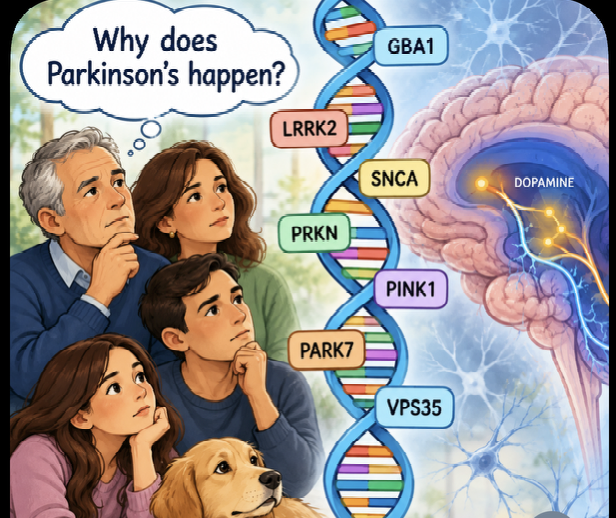
Parkinson’s disease (PD) is usually described as a disorder caused by the loss of dopamine-producing brain cells. But why those cells become vulnerable is more complicated. Research increasingly shows that genetics can play an important role—although PD is not simply an inherited disease.
About 10–15% of people with PD have an identifiable genetic link. In most people, however, the disease probably develops through a combination of aging, genetic susceptibility and environmental factors. Having a PD-related gene variant therefore does not necessarily mean that someone will develop PD.
Several genes have become especially important in PD research. GBA1 is the most common genetic risk factor identified in people with PD. The gene helps cells make an enzyme involved in the lysosome—the cell’s “recycling” system. Certain GBA1 variants may interfere with the removal of abnormal proteins, including alpha-synuclein, the protein that accumulates in Lewy bodies.
LRRK2 is another major PD gene. Some LRRK2 variants are inherited in an autosomal dominant pattern, meaning one altered copy can increase the chance of developing the disease. Importantly, not everyone who inherits a disease-associated LRRK2 variant develops PD, a concept known as reduced penetrance.
Other genes are less common but have provided important clues about PD biology. Variants in SNCA, the gene that produces alpha-synuclein, can cause rare inherited forms of PD. PRKN (parkin), PINK1 and PARK7 are associated particularly with younger-onset forms and are often inherited in an autosomal recessive pattern. VPS35 is another rare cause of dominantly inherited PD.
Why does this matter? Genetics is helping researchers divide PD into biological subtypes rather than treating it as one single disease. Clinical trials are already investigating therapies aimed at pathways involving genes such as GBA1 and LRRK2. In the future, a person’s genetic profile may help guide treatment choices.
Genetic testing is becoming more accessible, but results can be complicated. A positive result may indicate increased risk rather than certainty, while a negative result does not rule out PD. Testing may be particularly worth discussing in people with young-onset disease, a strong family history or ancestry associated with certain variants. Genetic counseling can help patients and families understand what a result does—and does not—mean.
The larger lesson from PD genetics is that genes are not destiny. Instead, they are providing a window into the cellular mechanisms that cause PD—and potentially pointing the way toward treatments designed to slow or prevent the disease.
The BeCare Parkinson’s App can help you track your symptoms to help you decide when to get evaluation for PD, and, if you are diagnosed, help guide treatment decisions. Be Aware with BeCare. Become a driver in your own neurologic journey.