
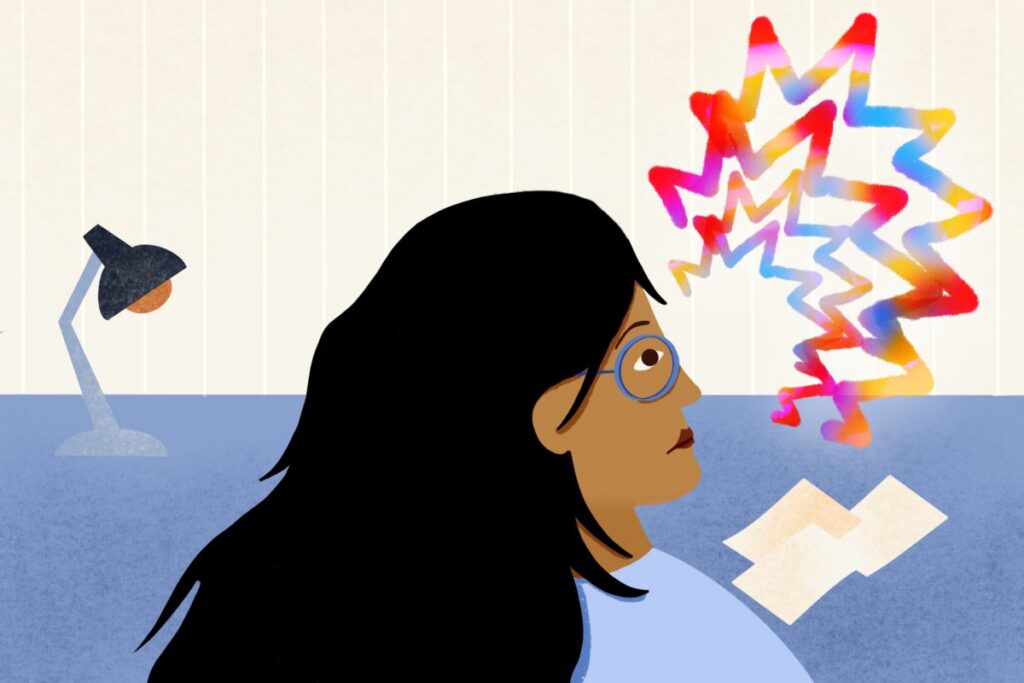
Vision changes are the most commonly associated symptom of migraine other than head pain. Some vision changes are part of a migraine aura, while others are not.
Uncomplicated blurred vision during a migraine is often not considered an aura. It can occur with or after the headache and is often accompanied by severe head pain, nausea, light and sound sensitivity, and brain fog.
Other forms of visual changes are considered migraine aura. About 25–30% of migraine sufferers experience aura, and among those who do, about 90% of the aura is visual in nature. Visual aura is much more common than motor, speech, or sensory aura.
Some of the hallmarks of visual aura are that they develop gradually over 15–20 minutes, last less than 60 minutes, and are usually fully reversible. Visual aura most commonly starts prior to the migraine, but sometimes can occur without any headache pain.
Not all visual aura are experienced in the same way. Below are some of the different types of visual aura.
-
Scintillating scotoma, which is often a colorful, zigzag shimmering pattern occurring on one side of your vision in both eyes at the same time. This pattern often starts centrally and expands laterally in a C-shaped pattern. These auras occur because of changes in the visual cortex and do not indicate any eye abnormality.
-
Partial visual field loss, experienced as a hemianopia (missing half of the visual field) or a quadrantanopia (missing a quarter of the visual field). People experience it as not being able to see half the room, words disappearing from a page, or bumping into things on the side where the vision is missing. Such visual loss is temporary and should resolve within 60 minutes. If it does not resolve, immediate medical attention should be sought to rule out other non-migrainous causes of visual loss.
-
Tunnel vision, in which the peripheral vision is intact but the central vision is missing. People describe it as feeling like they are looking through a tunnel.
-
Central visual loss, which is the opposite of tunnel vision. This may be described as a black spot in the central vision or as distortion and can make recognizing faces difficult.
-
Ocular or retinal migraine
This is much rarer than the typical migraine aura. It is described as visual loss in one eye only, can be experienced as complete or partial visual loss in that eye, and is often described as a curtain lowering over the eye. Because visual loss in one eye can signal more serious problems in the eye, this diagnosis can only be attributed to migraine when more serious causes are ruled out.
-
Silent migraine, or migraine without headache.
The bottom line is that visual loss or distortion is quite common during migraine. However, if symptoms start suddenly, do not resolve, or are monocular, they require immediate medical attention.
Becare Headache can help you monitor not only your headaches but also your symptoms, and offer education through AI and community support. Be empowered. Become a driver in your own headache journey.