
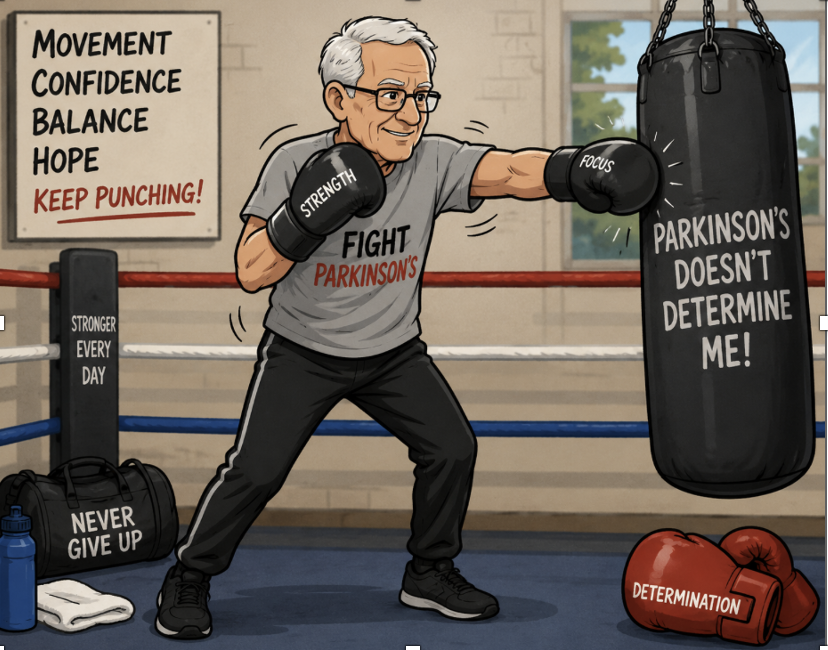
Receiving a diagnosis of Parkinson’s disease (PD) can feel overwhelming, but there is encouraging news: exercise is one of the most effective tools available to help manage symptoms. Among the many forms of exercise, one has attracted particular attention over the past decade—non-contact boxing.
No, this doesn’t mean getting into a boxing ring and taking punches. Instead, boxing therapy combines boxing-inspired movements with balance, strength, coordination, and aerobic exercises in a safe, supervised environment. For many people living with PD, it has become a powerful way to improve mobility, confidence, and quality of life. PD affects the brain’s ability to control movement. Common symptoms include slowness of movement, stiffness, tremor, balance problems, and difficulty walking. Research consistently shows that regular exercise can improve many of these symptoms.
A typical non-contact boxing class includes stretching, walking drills, footwork, punching bags or mitts, strength exercises, agility drills, dual-task activities, and cool-down stretching. Participants do not spar or get hit. When supervised by instructors experienced in Parkinson’s disease, boxing therapy is generally safe. Participating in a PD boxing class 2 to 3 times a week is the optimal frequency. Boxing therapy is far more than throwing punches. It is an engaging, evidence-based exercise program that can improve strength, balance, mobility, and confidence while fostering community that boosts the benefit of medical therapy.
BeCare Parkinson’s can help by monitoring your neurologic status, which helps you and your clinician determine in your therapy, including boxing is helpful. It helps tell you when to try new avenues of therapy. Be Aware with BeCare. Become empowered and be a driver in your own Parkinson’s journey.
