
Approximately 75% of Americans are treated by primary care doctors (PC). This means that 75% of Americans report most symptoms to their PC and often rely on their PC to detect any neurologic changes. It is of greatest importance that PC know when there is a neurologic condition that needs further evaluation by a neurologist and can work in partnership with the neurologist to make sure the patient receives the best care.
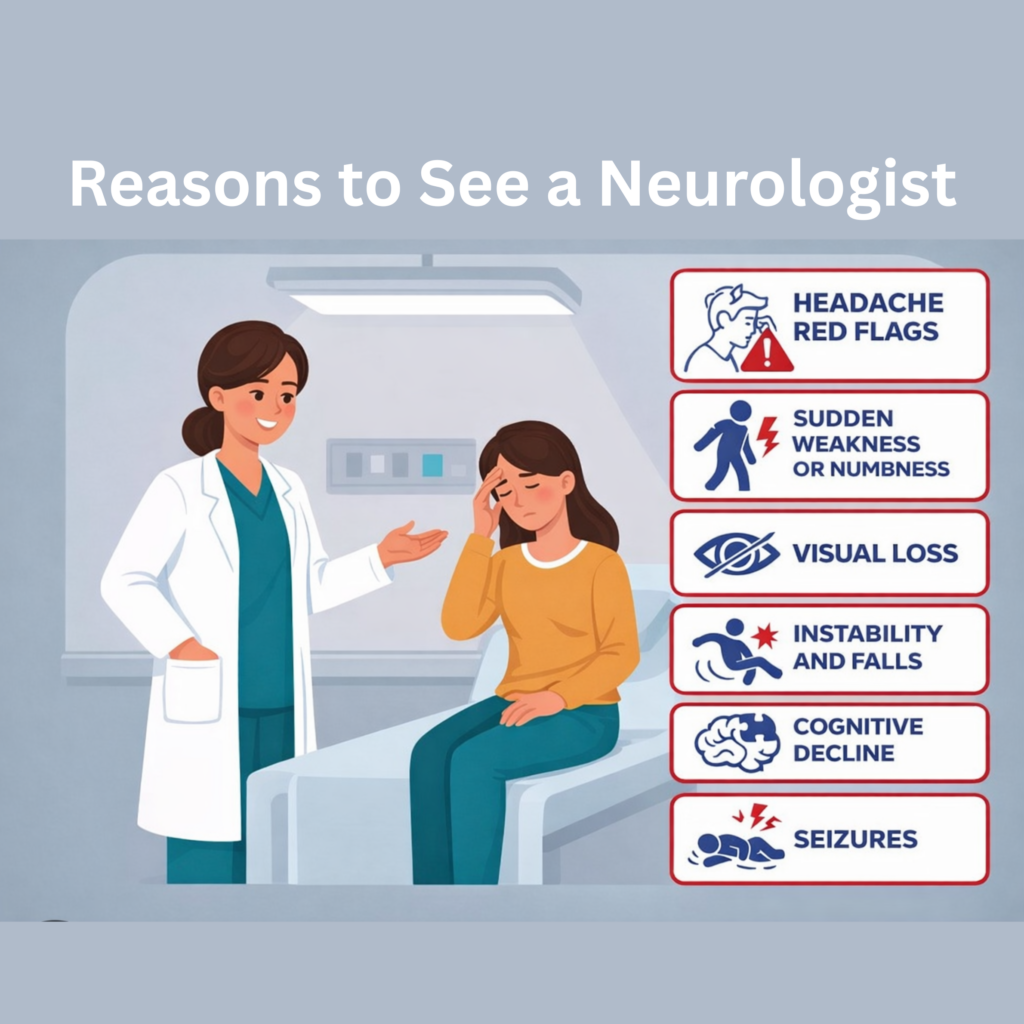
According to a recent article, the symptoms that should immediately alert a PC to the need to refer their patient to a neurologist are:
- HEADACHES
The Red Flags associated with a headache. That means that features of a headache that suggest there may be an underlying cause of a headache that requires immediate neurologic evaluation or care. These descriptions may suggest a mass in the brain, a brain bleed, an aneurysm, or meningitis.
- New or sudden onset of the headache
- Headaches described as “the worst headache of my life”
- Headaches associated with fever, focal weakness or change in mental status
- SUDDEN WEAKNESS OR NUMBNESS
- Acute unilateral (one sided) weakness or numbness of the face or one side of the body must be assumed to be stroke until proven otherwise and this requires immediate evaluation. Of course these symptoms could suggest migraine or even multiple sclerosis, but those diagnoses can only be considered after stroke has been ruled out.
- SUDDEN OR RAPIDLY ADVANCING VISUAL LOSS
- Unless this is a recurrent problem already attributed to migraine or a primary ocular issue, this is a neurologic emergency. It may suggest stroke, bleed, aneurysm, tumor or more.
- GAIT INSTABILITY AND FALLS
- Some of the potential causes are neuropathy, stroke, cervical myelopathy (problem in the cervical spinal cord) or even Parkinson’s Disease
- The neurologist will use your description of timing and other features as well as a detailed neurologic exam to help arrive at a diagnosis and proper treatment plan.
- COGNITIVE DECLINE
- Memory loss or other forms of cognitive impairment are not always a sign of normal aging, especially if there is rapid onset or worsening. At the same time, cognitive decline is not always due to Alzheimer’s Disease. There are many other considerations that neurologists train to detect and can be treated.
- NEW ONSET SEIZURES
- It is imperative that anyone who has a seizure, whether it is following a head injury or out of the blue, have an MRI brain, EEG (brain waves test like an EKG) and a neurologic evaluation to help determine the cause if one can be found (like a brain tumor). This information will help the neurologist predict if you are likely to have another seizure and whether medication (anticonvulsants should be started).
Primary Care doctors play a vital role in healthcare. They are attuned to when specialty care is needed, including neurology, cardiology, and pulmonology. BeCare Neuro and BeCare Headache Apps can help both you and your primary care doctor by delivering a quantified neurologic exam that detects cognitive decline, weakness, sensory loss, fall risk, tremor and more. Further the BeCare Headache can help identify the red flags so important in headache management and alert you when neurologic evaluation is needed. Be empowered. Become a driver in your own healthcare journey.