
The most common form of initially diagnosed MS (multiple sclerosis) is Relapsing Remitting MS, accounting for 85-90% of presenting patients. RRMS is characterized by distinct relapses followed by periods of partial or complete recovery. Over time, some patients transition to secondary progressive MS in which disability increases without distinct flares. The other traditionally recognized forms are CIS (Clinically Isolated Syndrome) in which there is only one recognized flare, RIS (Radiologically Isolated Syndrome) in which there are MRI changes without clinical symptoms and Primary Progressive MS (PPMS) in which the disease course is progressive from the beginning without distinct relapses (about 10% of patients).
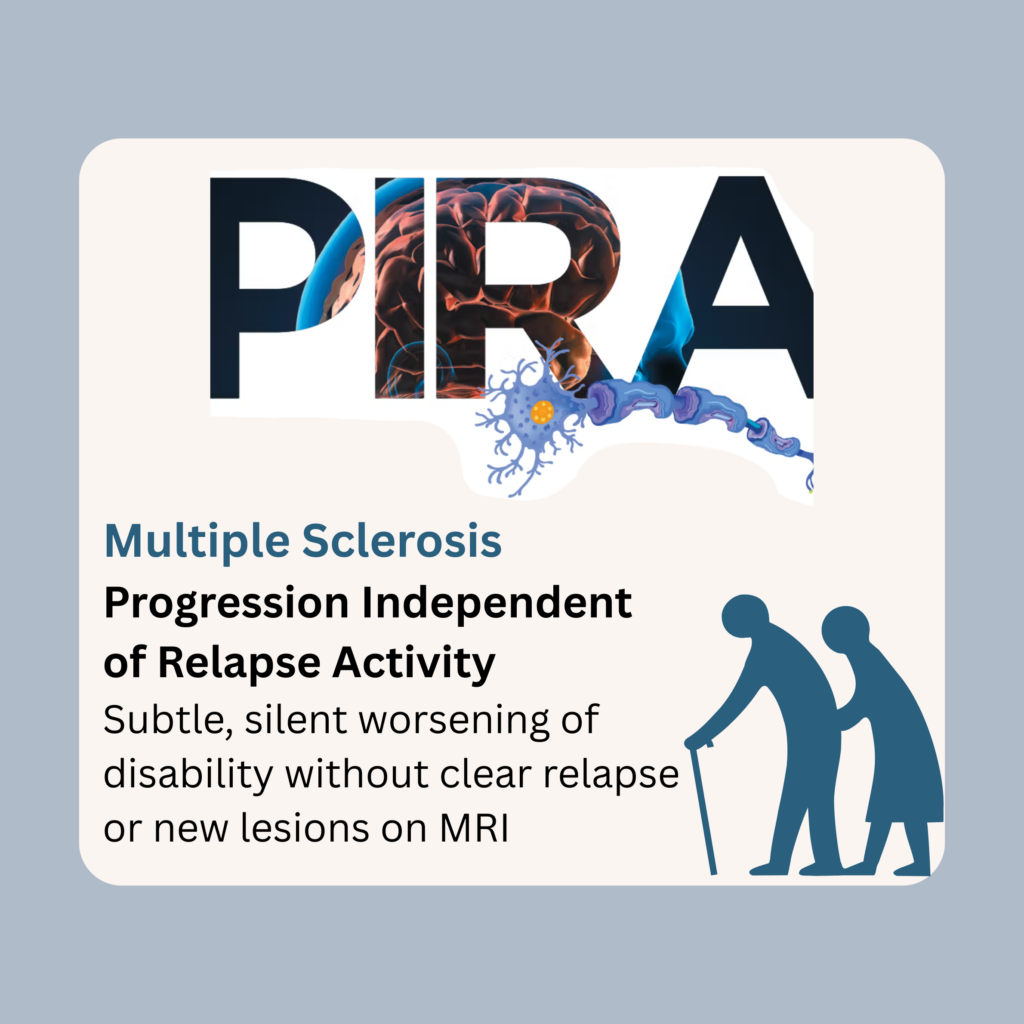
More recently, since about 2019, the term Progression Independent of Relapse Activity (PIRA) began appearing in the MS literature. The concept is that a substantial portion of disability worsening occurs without a preceding clinical relapse. This revolutionized the way neurologists conceptualize the basis of worsening disability. Previously, it was thought due to an accumulation of scarring from incomplete relapse recovery. With the notion of PIRA, neurologists now understand that disease progression as a silent, ongoing neurodegeneration even in previously designated relapsing disease. It can be thought of as a smoldering neuroinflammation with slow steady attacks on myelin. It doesn’t always occur only at the sites of active lesions. Why is this important? It justifies using the higher-efficacy (often with more adverse events) treatments earlier, abandoning the step wise choice of treatments that was based on a required number of clinical flares and MRI changes before initiating a “stronger” treatment with more potential adverse effects. It has also shifted monitoring for treatment efficacy by monitoring disability progression rather than on just relapse counts.
Because PIRA causes silent disability progression, rather than monitoring for optic neuritis or extremity weakness, neurologists now need to monitor for a slide in walking, fatigue, coordination and cognition. This is difficult because some of these changes can be dismissed as just a part of aging because they are not as clinically evident as a new flare.
The tools that your neurologist has to track PIRA include the gold standard disability scale called the Expanded Disability Status Scale (EDSS) which measures you motor function, coordination, and other components of neurologic function; Timed 25-Foot walk, and the 9-Hole Peg test which tests fine motor movement and coordination. BUT, the difficulty is that most patients with MS are not treated by neurologists but by primary care doctors who were not trained to perform and interpret these tests. Also, MOST neurologists who do not specialize in MS do not either. Further, in MS centers these tests are often performed by a different fellow (MS specialist in training) each year and not by the MS specialists because they are so time-consuming. The result is that the scores vary greatly between the different doctors who are performing them.
BeCare MS App can help. Through its gamified activities, the app quantifies the neurologic exam and through AI calculates scores for these monitoring tests, including the EDSS. The results have been validated at several academic centers. YOU can monitor your own progress and alert your treating doctor when it may be time to make a medication change that will change the trajectory of your disease. All of this can be done on your mobile app from home or wherever you are and you can both see the results yourself and have your doctor analyze a written report generated by the app. Be empowered. Become a driver in your own MS journey. Be aware with BeCare.