
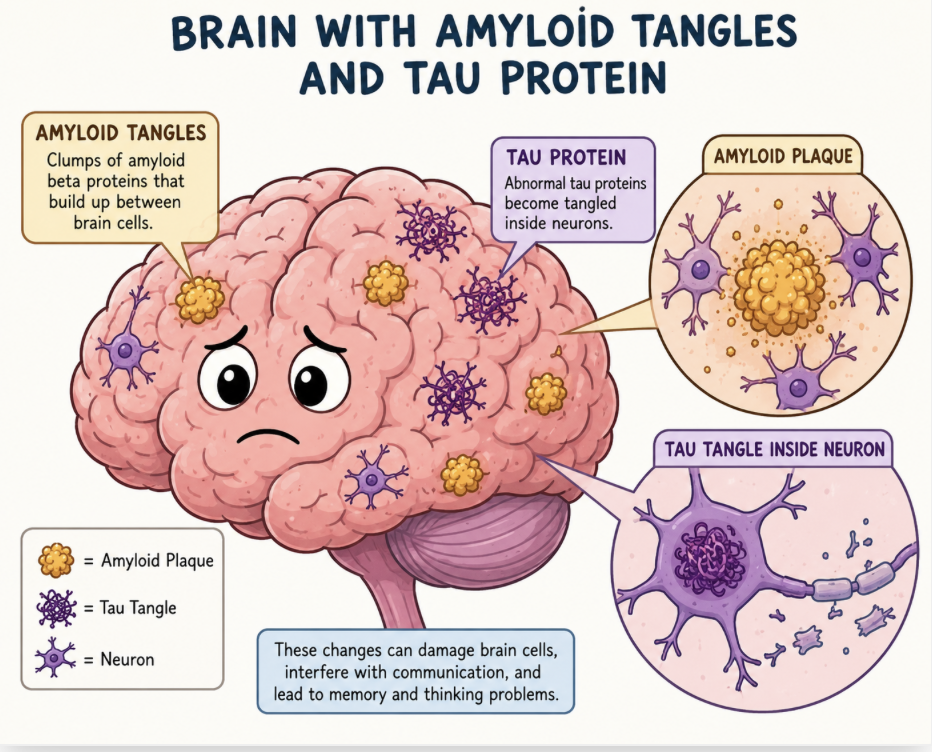
Diagnosing Alzheimer’s disease (AD) is undergoing a major transformation. For decades, physicians relied primarily on clinical symptoms and cognitive testing, with definitive confirmation possible only through advanced imaging or cerebrospinal fluid analysis. In recent years, blood tests for biomarkers have emerged as promising tools that may allow earlier and more accessible diagnosis.
The two main proteins involved in developing Alzheimer’s are called tau and amyloid. Tau can now be measured on the blood and excess amyloid demonstrated on a PET scan. Phosphorylated tau proteins, particularly p-tau217 and p-tau181, detected in the blood have shown remarkable accuracy in identifying AD. These advances raise an important question: how do blood tau tests compare with amyloid PET imaging using Amyvid®?
Amyvid PET scans has been an important breakthrough in Alzheimer’s diagnosis. The scan detects amyloid plaques within the brain, one of the hallmarks of the disease. A positive Amyvid PET scan provides strong evidence of having AD, while a negative study makes Alzheimer’s disease unlikely. However, PET scans are expensive, require specialized facilities, and may not be readily available in many communities.
Blood biomarkers offer a potentially simpler alternative. Tau proteins are normally involved in maintaining neuronal structure. In AD, abnormal forms of tau (phosphorylation and accumulation) contribute to neurodegeneration. Elevated levels of plasma p-tau217 and p-tau181 have been shown to correlate closely with amyloid plaque burden and tau pathology in the brain.
Several studies have demonstrated that plasma p-tau217 can identify Alzheimer’s pathology with almost the same accuracy as PET imaging. Some studies have reported diagnostic accuracies exceeding 85 to 90 percent. Both serum tau and Amyvid PET scans can become abnormal years before symptoms develop, allowing identification of individuals in the earliest stages of disease. This is critical as potent treatments for AD are very recently becoming available. The ones on the market today have potential toxicity and so starting them early can be dangerous if the disease is not confirmed.
One of the greatest advantages of blood testing is accessibility. A blood draw can be performed in virtually any clinical setting and costs significantly less than PET imaging. This has the potential to expand access to diagnostic evaluation and facilitate earlier intervention. Blood tests may also serve as screening tools to determine which patients are most likely to benefit from more advanced imaging studies.
Despite their promise, blood biomarkers have limitations. Laboratory methods continue to evolve, and cutoff values may vary among assays. Coexisting medical conditions can affect biomarker levels, and blood tests cannot provide anatomical information about the brain. In contrast, Amyvid PET imaging directly visualizes amyloid deposition and remains one of the most established methods for confirming Alzheimer pathology.
Rather than replacing PET imaging, blood tau biomarkers are likely to complement it. Many experts envision a two-step approach in which blood tests are used initially to identify patients at high risk for Alzheimer’s disease, followed by PET imaging when confirmation is needed or when treatment decisions depend on precise biomarker information. This strategy could reduce healthcare costs and improve access to diagnosis.
The future of Alzheimer’s diagnosis will likely involve a combination of blood biomarkers, imaging, and clinical assessment. Blood tau testing represents one of the most exciting developments in dementia care, offering the possibility of earlier diagnosis, broader access, and more personalized treatment. While Amyvid PET imaging remains a powerful diagnostic tool, blood biomarkers may soon transform the way clinicians identify and manage AD.
The BeCare Neuro App can help by helping detect cognitive impairment early and monitor for progression, both before and after treatment is initiated. Be Aware with BeCare. Become empowered and be a driver in your own neurologic journey.