
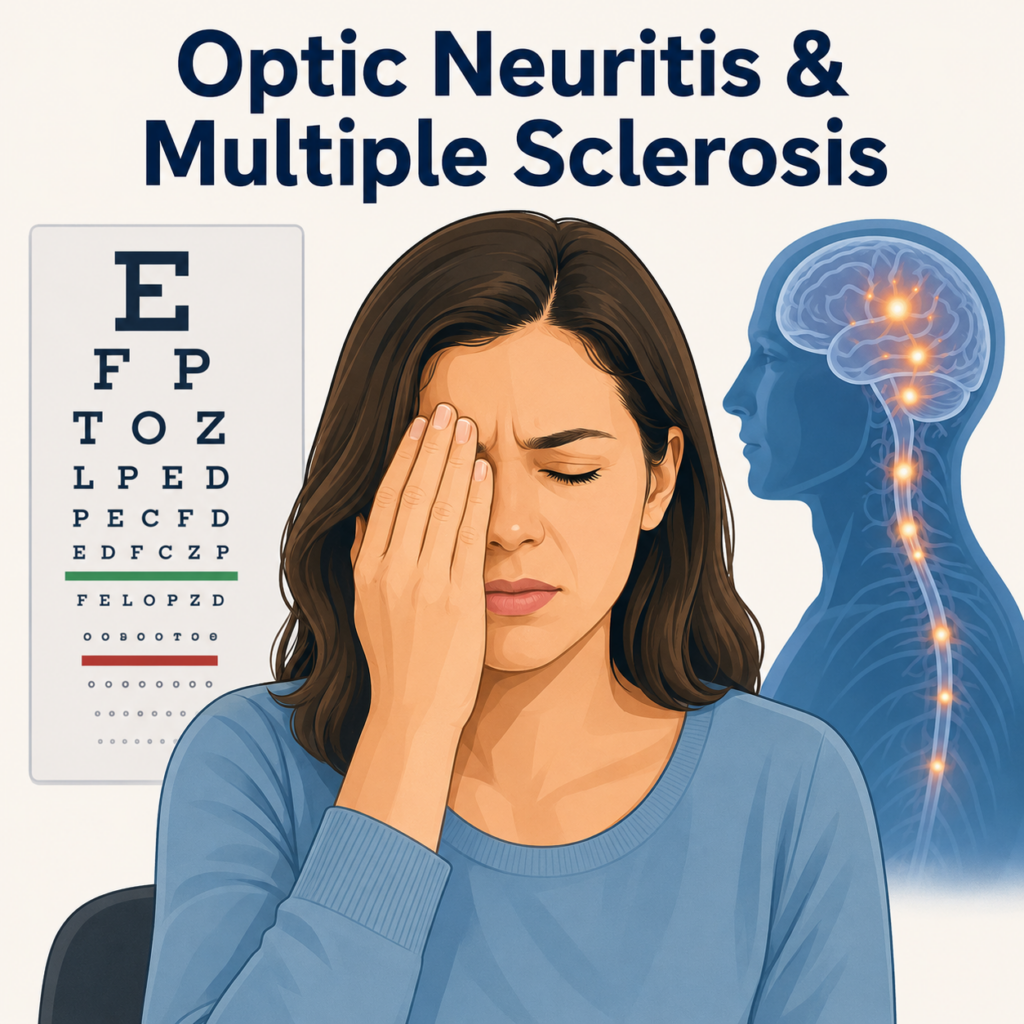
Optic neuritis is one of the most common and often earliest signs of multiple sclerosis (MS), a condition in which the body’s immune system mistakenly attacks the protective covering of nerves in the brain and spinal cord. When this inflammation affects the optic nerve—the structure that carries visual information from the eye to the brain—it can lead to sudden and sometimes alarming vision changes.
What is optic neuritis?
The optic nerve acts like a cable, transmitting visual signals so the brain can interpret what you see. In optic neuritis, inflammation disrupts this signal. In people with MS, this inflammation is caused by damage to myelin, the insulating layer around nerve fibers. Without healthy myelin, messages from the eye to the brain become slowed or distorted.
For some individuals, optic neuritis is the first clue that MS may be present. Others may develop it later in the course of the disease.
What symptoms should you look for?
Optic neuritis typically affects one eye at a time, though both eyes can be involved in rare cases. Symptoms usually develop over hours to a few days and may include:
– Vision loss: This can range from mild blurriness to significant loss of vision. Some people describe a “smudge” or dark spot in the center of their vision.
– Eye pain: Often worsens with eye movement and is a key distinguishing feature.
– Color vision changes: Colors may appear dull or “washed out,” especially reds.
– Flashing lights: Some people notice flickering or flashing when moving their eyes.
– Reduced contrast sensitivity: Difficulty distinguishing objects from their background.
A classic feature is that vision may worsen temporarily with heat or exercise—a phenomenon known as Uhthoff’s phenomenon.
How is it related to multiple sclerosis?
Optic neuritis is closely linked to MS because both involve immune-mediated damage to myelin. In fact, a significant number of people who experience optic neuritis—especially younger adults—may go on to be diagnosed with MS, particularly if brain imaging shows additional areas of inflammation.
Doctors often use magnetic resonance imaging (MRI) to look for these changes. The presence of lesions elsewhere in the brain increases the likelihood that optic neuritis is part of MS rather than an isolated event.
The good news is that most people experience substantial recovery of vision within weeks to months. However, recovery may not be complete. Subtle issues—like reduced color vision or contrast sensitivity—can persist even after eyesight seems to return to normal.
Repeated episodes can lead to cumulative damage, potentially resulting in more lasting visual impairment over time.
Treatment depends on the severity of symptoms and the individual situation. In many cases, optic neuritis improves on its own. However, doctors may recommend:
– High-dose corticosteroids (such as methylprednisolone): These can speed up recovery, though they do not necessarily change the final level of vision regained.
– Disease-modifying therapies for MS: If optic neuritis is part of MS, long-term medications may be started to reduce future relapses and slow disease progression.
You should seek immediate evaluation by your neurologist, opthalmologist or primary care doctor with any sudden vision change, especially when accompanied by eye pain. While optic neuritis is a common cause of visual loss in younger adults, other conditions can also affect vision and need to be ruled out by your clinician.
The BeCare MS App can help, both by detecting a decline in your visual acuity and ability to discriminate colors and also by detecting other abnormalities in your neurologic function on your remote mobile phone-based quantitative and game-like neurologic exam. Be Aware with BeCare. Become empowered and be a driver in your own neurologic health.